

Hyatt_Foundation Story
On this day in history:
27 September 1957: Hyatt was founded
September 27th marks the official founding day of Hyatt Hotels—a brand that today stands as a titan of global luxury and corporate hospitality. With over 1,300 properties across 76 countries, Hyatt is synonymous with world-class elegance, soaring atrium lobbies, and premium business travel.
Yet, long before it became a multi-billion-dollar hospitality empire, Hyatt's story began with an accidental discovery at a noisy airport runway, a scribbled offer on a paper napkin, and a visionary bet on the future of modern travel.
The $2.2 Million Napkin Deal: How a Single LAX Motel Born Hyatt Hotels

In 1957, air travel was entering its golden age. Commercial jets were faster, business trips were multiplying, and executives were flying across the United States in unprecedented numbers.
Unlike today, airports had limited connectivity- no mobile phone, expensive telephone calls, public cabs only and no place to spend the night. When these travelers landed late at night or faced long layovers, their accommodation options near airports were awful—cramped, noisy, low-budget motels offering little more than a bed and a flickering lamp.
Enter Jay Pritzker, a 35-year-old lawyer and sharp dealmaker from Chicago. What began as a routine business trip to Los Angeles turned into one of the most famous spur-of-the-moment acquisitions in corporate history—giving birth to Hyatt.
1. The Spotting of an Unmet Need
On a brisk morning at Los Angeles International Airport (LAX), Jay Pritzker walked into the coffee shop of the Hyatt House motel. The property was owned by a local businessman named Hyatt von Dehn.
Pritzker noticed something that defied traditional hotel logic of the 1950s:
The motel wasn't located in a glamorous downtown core or near a scenic resort beach.
It sat directly on the perimeter of a noisy, bustling airport runway.
Yet, every single room was booked solid.
While traditional hotel chains viewed airport areas as undesirable industrial zones, Pritzker recognized a massive shift in consumer behavior. High-powered business executives needed quality, convenience, and comfort right where their planes landed—not a 90-minute commute into city traffic after a midnight flight.
2. The $2.2 Million Napkin Offer
Convinced that airport lodging represented an untouched goldmine, Jay Pritzker didn't wait to return to Chicago or consult a board of directors.
He approached Hyatt von Dehn right there in the coffee shop and wrote a scribbled offer on a paper napkin to buy the motel for $2.2 million. Von Dehn accepted, and on September 27, 1957, the Hyatt brand was officially launched under Pritzker ownership.
3. The Strategy: Scaling the "Airport Hotel" Concept
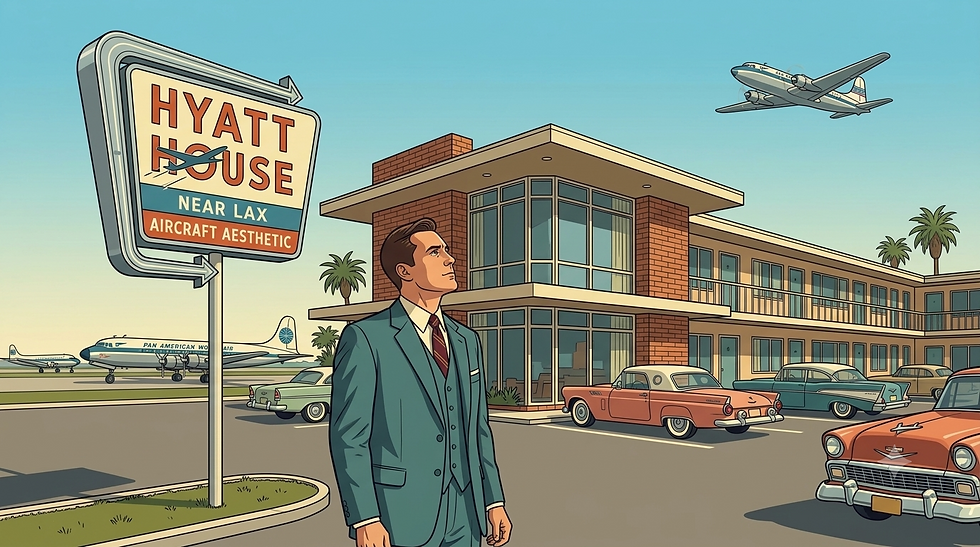
Buying the LAX property was just the spark. The Pritzker family—led by Jay and his brother Donald—immediately recognized that the LAX phenomenon wasn't a fluke; it was a repeatable business model.
Within two years, the Pritzkers opened Hyatt House properties near:
San Francisco International Airport (SFO)
Seattle-Tacoma International Airport (SEA)
Hyatt effectively pioneered the concept of the premium airport hotel, creating a network of comfortable, full-service sanctuaries tailored specifically for frequent business travelers.
Key Business Takeaways from Hyatt’s Origin
What can entrepreneurs, investors, and business enthusiasts learn from Jay Pritzker's $2.2 million napkin deal?
Look for Friction Points: Pritzker paid attention to where customers experienced discomfort (cramped, low-quality accommodations after long flights) and built a high-value solution right at the point of arrival.
First-Mover Advantage in Niche Locations: While competitors fought for expensive real estate in city centers, Hyatt captured prime airport land before the rest of the industry realized its value.
Decisive Action: The ability to evaluate unit economics quickly allowed Pritzker to make a bold move before larger, bureaucratic competitors even saw the opportunity.
Comments